
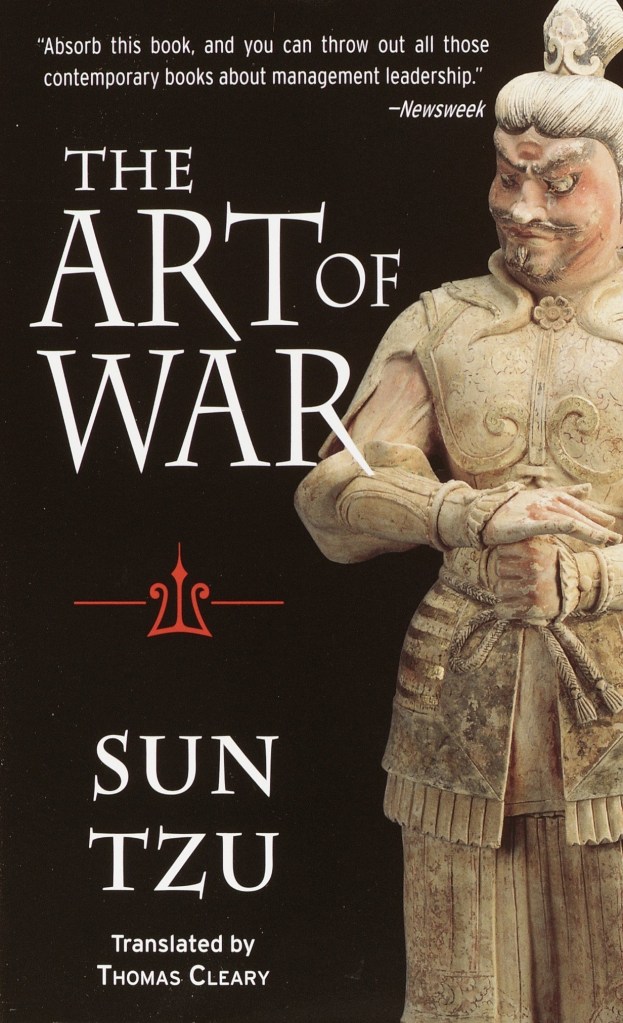
The Art of War is an ancient Chinese military treatise dating from the Late Spring and Autumn Period (roughly 5th century BC). The book contains a detailed explanation and analysis of the 5th-century BC Chinese military, from weapons, environmental conditions, and strategy to rank and discipline. For almost 1,500 years it was the lead text in an anthology that was formalized as the Seven Military Classics. Sima Qian’s Records of the Grand Historian, the first of China’s 24 dynastic histories, records an early tradition that a text on military matters was written by one “Sun Wu” (孫武) from the State of Qi. This text was traditionally identified with the received Master Sun’s Art of War.
The conventional view is that Sun Wu was a military theorist who fled his home state of Qi to the southeastern kingdom of Wu. Beginning around the 12th century, some Chinese scholars began to doubt the historical existence of Sun Tzu. The name “Sun Wu” does not appear in any text prior to the Records of the Grand Historian. In 1972, the Yinqueshan Han slips were discovered in two Han dynasty tombs near the city of Linyi in Shandong Province. This discovery showed that much of the historical confusion was due to the fact that there were two texts that could have been referred to as “Master Sun’s Art of War”, not one.
During the Sengoku period (c. 1467–1568), the Japanese daimyō Takeda Shingen is said to have become almost invincible in all battles without relying on guns. General Võ Nguyên Giáp successfully implemented tactics described in The Art of War during the Battle of Dien Bien Phu. The book is used as instructional material at the US Military Academy at West Point. The Art of War has been applied to many fields outside of the military. Much of the text is about how to outsmart one’s opponent without actually having to engage in physical battle.
It has found application as a training guide for many competitive endeavors that do not involve actual combat. Many business books have applied lessons taken from the book to office politics and corporate business strategy. The Art of War is often quoted while developing tactics and/or strategy in esports. It has also been applied in sports, most notably by Brazil’s 2002 World Cup-winning coach Luiz Felipe Scolari. In the 1987 movie Wall Street, Gordon Gekko (Michael Douglas) frequently references it. The 20th James Bond film, Die Another Day (2002) also references The Art Of War as well as Colonel Moon and his father.
 Random Citizen