
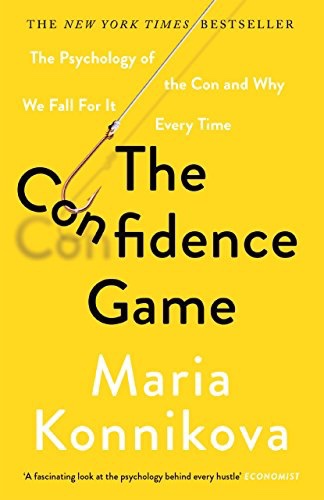
Everybody has a weak spot that can be exploited by con artists – yours just might be different from someone else’s. By learning about the personal and psychological weaknesses con artists manipulate, you can understand how they operate and how to keep yourself safe. How an optimistic mindset turned a professor into a criminal and how one little boy scammed the entire U.S. economy are just some of the ways that tricksters manipulate their victims. Getting too close to people can reveal uncomfortable truths, even when it comes to close relationships. Sometimes we unconsciously turn a blind eye to emotional cues that might give us a deeper understanding of someone else.
The more we learn about people, the more we’re able to tell if they might find us boring or if they’re being disingenuous towards us. A con artist has to gain their victim’s trust, as illustrated by the case of Debra and her psychic. However, there’s more to the process of manipulating someone than simply identifying their vulnerabilities. Joan fell in love with a man named Greg who seemed perfect in every way except for one: he didn’t have any friends or family. As more holes appeared in his story, Joan soon realized that her boyfriend had spent two years charming her into believing a lie.
People are drawn to those they perceive as being similar to themselves and they’re more likely to trust people with whom they have a lot in common. But con artists know that similarity can be mimicked for manipulative purposes by pretending to share someone else’s interests or values. This can be scarily effective because human beings are often so subconsciously egotistical that we automatically like or trust them a little more.
If you take time out of your day to get engaged in a conversation about a cause, you’ll feel compelled to do something about it. Stay-at-home moms were 30% more likely to spend two hours on the phone answering questions in a survey if they had previously agreed to take a moment and answer “just a few questions”. This is what’s known as the “foot in the door” strategy and it’s what con artists employ all the time. “Bill Morrison the Nigerian prince” was actually a 14-year-old American boy who had cooked up the scheme for fun. In 1900, people all across the United States sent him $4.00 at a time, in the economy of 1900, that really started to add up.
Once a con artist gets their foot in-door via a small request, they have the opportunity to go farther and cause more significant damage. Con artists are experts at pinpointing our self-perception blind spots. Chances are, we’ve all looked ridiculously without realizing it. In 2012, an otherwise very intelligent university professor fell for a picture of a beautiful model he saw on the internet. Although the two exchanged some instant messages online, they never spoke on the phone or saw each other on Skype.
The moral of this story might be internet safety, but more aptly, it might be to cultivate awareness of our blindspots. Because we might not know a lot about human psychology or how it can be applied to us — but con artists know a whole lot.
Con artists are able to tap into our inherent optimism and exploit it for personal gain. Our eagerness to believe in a con artist’s scheme stems from the fact that people are naturally inclined to be optimistic about the future. William Miller’s victims knew that only too well because he asked each of his friends to donate $10 to his business as start-up capital. Each of humanity’s most endearing qualities — compassion, generosity, hope — can be manipulated by those who seek to abuse them. And the same is true of our commitment to our personal beliefs.
When people have an experience that contradicts their beliefs, they’ll cling to those beliefs even if it means suppressing the experience. Con artists use this to reinforce our trust in them and ensnare us tighter in their web. A survey has revealed that 65% of all conversations revolve around gossip. Our reputation is one of the biggest concerns in our lives and we’re reluctant to damage it. More than almost any other topic, we’re concerned with how other people think about us more than how we behave.
We care so much about our perception in the eyes of others that psychologist Robin Dunbar’s 1997 study found that 65%. A good reputation is also a shortcut for gaining people’s trust even if they don’t know us personally, which is why it can be a valuable social commodity. It can also be a great tool for con artists as evidenced by a highly effective scam from 1915. Not one of the seventy thousand victims spoke out because they feared losing their reputation.
 Random Citizen