
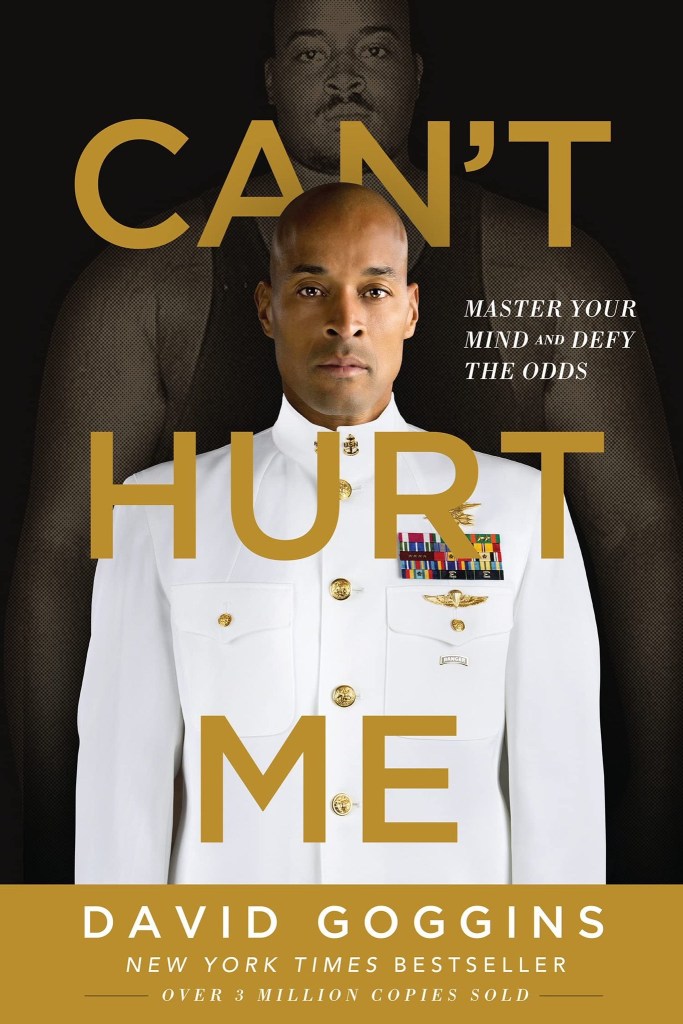
In Can’t Hurt Me, Goggins shares his incredible story of overcoming adversity to become a U.S. Armed Forces icon and one of the world’s top endurance athletes. He is the only man in history to complete elite training as a Navy SEAL, Army Ranger, and Air Force Tactical Air Controller. His father, Trunnis, was an abusive father who made his family work almost every night at a roller disco rink while making them all work full-time. As a child, Goggins Trunnis witnessed his father beat his mother senselessly with a belt and when he intervened, his father would beat him too.
He was placed in a special needs classroom and started cheating his way through school. By the time he was in his teenage years, he could barely read and had lost pigment in his skin. Toxic stress causes changes to the brain that put the body in a permanent state of “fight or flight”. Goggins was afraid of water and didn’t see a pool until he was twelve and was deathly afraid of swimming at the age of twelve. During his military training, he became paralyzed by fear and failed to overcome his swimming challenges. Goggins walked away from the military on medical grounds because he was predisposed to sickle cell anemia.
After leaving the military, Goggins was working as an overnight exterminator in Indianapolis. One morning he stumbled upon a TV documentary about the Navy SEALs. He would need to lose 107 pounds in less than three months if he wanted a fighting chance at becoming a Navy SEAL. Over the next three months, he implemented a strict fitness regimen. Navy SEAL Ryan Goggins developed the concept of the armored mind during training. During Hell Week, candidates are exposed to life-threatening conditions at sea and are incredibly sleep-deprived.
This week is so hard that people often die during this week. To raise money for his fellow SEALs’ families, he chose to combine charity with running the Badwater 135. Goggins had never run more than 26 miles of a marathon before. At 70 miles into the race, he lost control of his bladder and bowel movements due to sheer exhaustion. He was experiencing double vision and was running on broken bones in his feet.
Goggins completed his race in 19 hours and qualified for the Badwater 135 ultramarathon. This time he would be running through California’s Death Valley and finishing the race at an elevation of 8,374 feet.
After completing the Badwater 135, Goggins was thriving, entering himself into races a month for months on end. During one of his races, he noticed an irregular heart rate and a trip to the hospital revealed a lifelong condition: a hole in his heart. Miraculously, his condition hadn’t killed him. Now that his running career was over, how would he continue to push himself? He came up with a new strategy and broke the World Record for pull-ups.
Goggins was doomed for a life of depression, violence, and unfulfilled potential. He lost weight and studied hard to get into the BUD/S training program. A typical day for Goggins begins at 4 a.m. when he wakes up and goes for a six-to-ten mile run. He then bikes 25 miles to work and arrives at his desk by 7:30.
During his lunch break, he will either complete a gym session or go for another six-mile run on a beach. After work, he cycles the 25 miles back home after work. Goggins overcame his traumatic childhood by simply working hard and committing himself to his goals. After failing to overcome his fear of swimming and then gaining weight, he decided to join the Navy SEALs. In just three months, he lost over 100 pounds and was accepted into the training program. This mindset allowed him to accomplish the seemingly impossible and become a successful ultramarathon runner.
 Random Citizen